
Modular Construction Transforming Seychelles’ Education Sector
Fortunately, a solution is just a click away: modular school infrastructure that enables educational institutions in Seychelles to expand and modernise its education facilities faster, more affordably and with far greater flexibility than traditional construction ever could.
At Afripanel, we help education authorities, private schools and developers deliver modular classrooms and modular school infrastructure that meet immediate needs while remaining adaptable for the future. We do this with proven systems, full customisation and practical experience delivering education buildings across Africa.
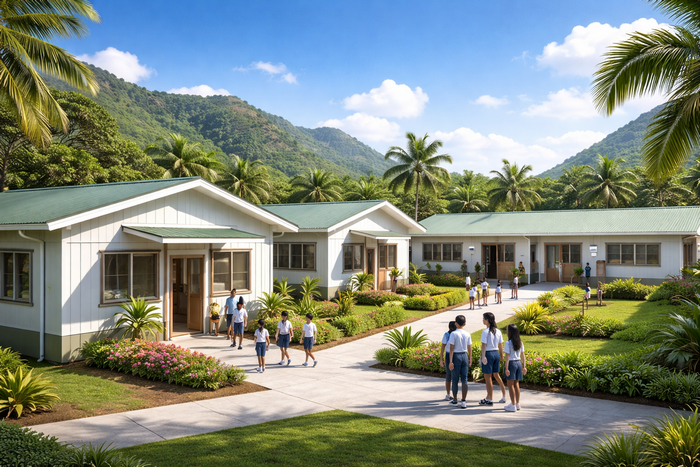
Table of Contents
- Why Seychelles Needs Modular School Infrastructure Now
- Key Challenges Facing Seychelles’ Education Sector
- Why Modular Classrooms Are the Right Solution
- How Afripanel Supports Education Projects in Seychelles
- Modular School Buildings Afripanel Can Deliver
- Pre-Designed Classroom Templates and Full Custom Builds
- Proven Education Infrastructure Experience Across Africa
- Modular vs Traditional School Construction
- Opportunities and Long-Term Impact for Seychelles
- Why Choose Afripanel
- Frequently Asked Questions
- Build Smarter Learning Environments with Afripanel
Why Seychelles Needs Modular School Infrastructure Now
Education is one of Seychelles’ most important long-term investments. Government policy, international development programmes and public spending all reinforce the role of education in economic resilience, skills development and social stability. World Bank and UNESCO data consistently show that Seychelles invests a meaningful share of GDP into education, underlining how critical the sector is to national development.
So, the challenge is not commitment. The challenge is delivery.
Schools need new classrooms, specialist teaching spaces, staff facilities and support buildings, often faster than conventional construction can provide. Delays do not just affect budgets. They disrupt academic calendars, overcrowd classrooms and put pressure on teachers and learners alike.
Modular classrooms provide a practical way forward. With prefabricated modular construction, schools can add capacity quickly, expand in phases and adapt buildings as enrolment and curriculum needs change. Afripanel makes this possible by supplying insulated modular panels that allow modern school buildings to be assembled on site in a fraction of the time required for brick-and-mortar construction.
Key Challenges Facing Seychelles’ Education Sector
Seychelles faces several education infrastructure challenges that are common to island nations and small economies but amplified by geography and logistics.
Growing enrolment and space constraints
As populations shift and school-age numbers fluctuate, some schools face overcrowding while others need to reconfigure existing facilities. Building permanent structures for every short-term spike is costly and inefficient.
Limited land availability
Available land is scarce and valuable. School buildings need to be space-efficient and adaptable, not rigid structures that cannot be changed later.
Dependence on imported construction materials
Most traditional building materials are imported, increasing costs and exposing projects to global supply chain disruptions. Delays in materials lead directly to delayed classrooms.
Disruption to teaching during construction
Traditional construction is noisy, disruptive and often unsafe around active school environments. This affects both learning outcomes and school operations.
Rising construction costs
Labour shortages and escalating material costs make conventional school construction slower and more expensive than ever before.
Each of these challenges points toward the same conclusion: modular school infrastructure that offers a faster, cleaner and more flexible alternative.
Why Modular Classrooms Are the Right Solution
Modular construction changes how schools expand and modernise. Instead of long, site-intensive build programmes, modular systems rely on precision manufacturing and rapid on-site assembly.
For Seychelles, the benefits are immediate.
Speed that matches demand
Modular buildings can be delivered up to six times faster than traditional construction. This allows schools to respond to enrolment growth without waiting years for new facilities.
Minimal disruption to learning
Because most of the manufacturing happens off site, construction on school grounds is neater, quieter and safer. Teaching can continue with minimal interruption.
Built for long-term use
Modular classrooms are not temporary stopgaps. Afripanel designs and manufactures its own panels to standards comparable with traditional building materials, ensuring excellent quality and durability.
Energy-efficient learning environments
Built-in insulation creates comfortable classrooms throughout the year while also reducing heating and cooling costs. This matters in Seychelles’ warm, humid climate where energy efficiency directly impacts operating budgets.
Infrastructure that adapts over time
Modular buildings offer extreme flexibility. Classrooms can be expanded, reconfigured or relocated as needs change, protecting long-term investment.
How Afripanel Supports Education Projects in Seychelles
At Afripanel, we specialise in modular prefabricated buildings assembled on site. Our role is to supply the engineered building systems that make fast, reliable school construction possible.
From our factory in Kempton Park, Johannesburg, South Africa, we manufacture insulated wall, roof and ceiling panels and ship them using cross-border freight to projects across Sub-Saharan Africa. This includes island and remote locations where logistics expertise is essential.
For education projects in Seychelles, we offer two primary delivery approaches:
- Turnkey solutions, where buildings are delivered complete with fittings, plumbing, electrics and air conditioning
- Supply-only solutions, where panels are delivered for local assembly, with optional assistance if required
This flexibility allows you to match the delivery model to your budget, timeline and local resources.
Modular School Buildings Afripanel Can Deliver
Afripanel supports every aspect of a modern school campus. Our modular systems can be used to create:
Modular classrooms
Comfortable, well-insulated teaching spaces suitable for primary, secondary and tertiary education.
Administration and staff buildings
Offices for principals, teachers, counsellors and administrative staff, designed for efficient daily operations.
Ablution facilities
Standalone or integrated toilet blocks, including staff and learner ablutions, designed for durability and hygiene.
Specialised learning spaces
Libraries, computer rooms, laboratories, staff rooms and multi-purpose halls can all be delivered using the same modular system.
All buildings can be supplied as turnkey solutions or as panel systems ready for assembly.
Pre-Designed Classroom Templates and Full Custom Builds
Afripanel offers six pre-designed school building templates (SCH-1 through SCH-6). These templates range from smaller single-classroom units to larger classroom blocks with verandas and integrated ablution facilities.
The key rule is simple and always applies: all designs are templates only.
You are never limited to these layouts. They exist to speed up planning, not to restrict your options. You may:
- Modify any template
- Combine multiple templates
- Resize classrooms
- Change internal layouts
- Or provide your own complete architectural design
Our in-house engineers will then design and manufacture the panels to match your requirements, within reason. This level of highly customised solutions is one of Afripanel’s strongest differentiators.
Proven Education Infrastructure Experience Across Africa
Afripanel’s education expertise is grounded in real-world delivery. Over the past two decades, we have supported education and community infrastructure projects across Africa.
Our experience includes but is not limited to:
- Classroom buildings in South Africa
- Education facilities in Namibia
- School and community infrastructure in Zambia
- Multi-building developments requiring phased delivery
This experience matters. It means we understand how to design buildings that perform in challenging environments, how to manage logistics to remote locations, and how to deliver infrastructure that works from day one.
Modular vs Traditional School Construction
When planning new education infrastructure, decision-makers often compare modular construction with conventional building methods. The differences are clear.
| Factor | Modular School Infrastructure | Traditional Construction |
|---|---|---|
| Construction time | Up to six times faster | Long, unpredictable timelines |
| Site disruption | Neater, quieter and safer | Noisy, disruptive environments |
| Cost control | High predictability | Higher risk of overruns |
| Flexibility | Expandable and reconfigurable | Rigid, difficult to adapt |
| Energy efficiency | Excellent built-in insulation | Variable performance |
For Seychelles, modular construction offers a smarter balance of speed, cost and long-term value.
Opportunities and Long-Term Impact for Seychelles
Investing in modular school infrastructure opens up long-term opportunities for the education sector and the wider economy.
Faster response to demographic change
Schools can expand capacity quickly without waiting years for approvals and construction.
Better learning environments
Comfortable, well-designed classrooms improve concentration, attendance and teacher satisfaction.
Smarter public spending
An affordable alternative to traditional construction, modular buildings can deliver savings of up to 30 percent while maintaining quality.
Future-ready campuses
As curriculum needs evolve, modular buildings can be adapted rather than replaced, extending their useful life.
By adopting modular classrooms and modular school infrastructure, Seychelles can strengthen its education system while maintaining fiscal discipline and flexibility.
Why Choose Afripanel
When you choose Afripanel, you gain a partner with proven systems and decades of experience.
We offer:
- Highly customised solutions signed off by in-house engineers
- Turnkey solutions including plumbing, electrics and air conditioning, with optional solar power, gas water heaters and rainwater harvesting
- Up to six times faster construction
- Neater, quieter and safer construction sites
- Excellent quality and durability through in-house panel manufacturing
- Unbeatable value through direct-from-manufacturer pricing
- Low maintenance buildings designed for longevity
- Excellent energy efficiency through built-in insulation
- Superb service backed by more than 20 years of experience
- End-to-end solutions or DIY options
- Extreme flexibility for future expansion or reconfiguration
- Affordable construction with savings of up to 30 percent
- Cross-border freight expertise across Sub-Saharan Africa
Frequently Asked Questions
Are modular classrooms suitable for permanent schools?
Yes. Afripanel’s modular buildings are designed for long-term use and perform like permanent structures.
Can classrooms be expanded later?
Yes. Modular systems are designed to be expanded or reconfigured as enrolment changes.
Do we have to use pre-designed templates?
No. All designs are templates only. You can provide your own design and we will build to specification within reason.
How fast can a modular school building be delivered?
Projects can be completed up to six times faster than traditional construction, depending on scope.
Build Smarter Learning Environments with Afripanel
Seychelles’ education sector needs infrastructure that can keep up with demand without compromising quality or budgets. Modular construction provides that path.
At Afripanel, we help you deliver modular classrooms and modular school infrastructure that are fast to build, flexible to use and built to last. Whether you need a single classroom or a full school campus, we are ready to support your project.
Complete the form below to speak with our team and explore how Afripanel can support your education infrastructure needs in Seychelles.
Sources Consulted:
Seychelles Prepares for Digital Transformation in Teacher Development
Publisher: Commonwealth of Learning
Summary: This article outlines current challenges in Seychelles’ education sector, including teacher quality pressures, limited digital access, infrastructure constraints, and the need for modernised learning environments to support future-ready education.
https://www.col.org/news/seychelles-prepares-for-digital-transformation-in-teacher-development/
You RISE: Youth Resilience, Inclusion, Support and Empowerment – Project Information Document
Publisher: The World Bank
Summary: This World Bank project document highlights the role of education in improving youth outcomes in Seychelles, linking education infrastructure, skills development, and employability to long-term economic resilience and growth.
https://documents1.worldbank.org/curated/en/099010325103020825/pdf/P507578156005408183a21e5d8b35b8590.pdf
Seychelles: Education for a Learning Society – Policy Statement
Publisher: UNESCO Institute for Lifelong Learning
Summary: This policy statement sets out Seychelles’ national vision for education, emphasising quality, inclusion, lifelong learning, and the need for adaptable, fit-for-purpose education infrastructure to support evolving teaching and learning models.
https://www.uil.unesco.org/sites/default/files/medias/fichiers/2023/05/seychelles-education-for-a-learning-society-policy-statement.pdf
Government Expenditure on Education, Total (% of GDP) – Seychelles
Publisher: The World Bank (UNESCO Institute for Statistics)
Summary: This dataset provides insight into Seychelles’ public investment in education as a percentage of GDP, reinforcing the sector’s economic importance and the need for efficient, scalable infrastructure delivery.
https://data.worldbank.org/indicator/SE.XPD.TOTL.GD.ZS?locations=SC