 :
:  :
: 
Modular Buildings Strengthening Healthcare Infrastructure in Zambia
Modular healthcare buildings offer this solution and can deploy at scale.
Zambia currently spends approximately 2.5 percent of GDP on health, with rising allocations in absolute terms, yet infrastructure demand continues to outpace supply.
National planning documents emphasise the need to provide quality health services as close to families as possible. However, many facilities still struggle with inadequate buildings, unreliable utilities and insufficient space.
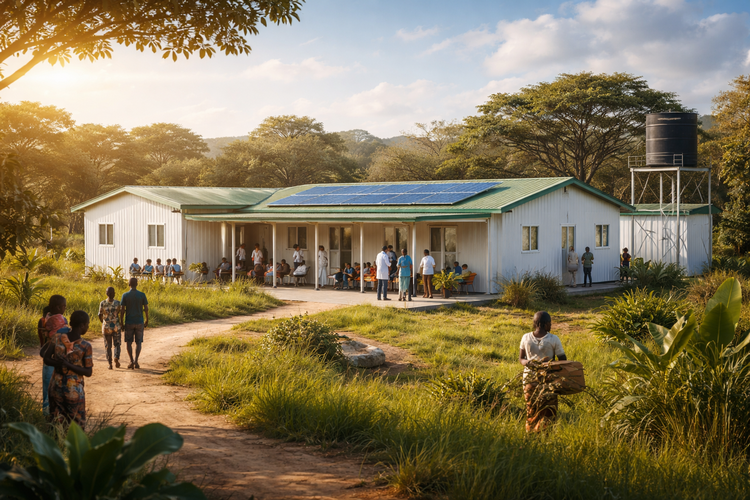
In rural areas, the infrastructure challenge becomes deeply practical. As reported in recent field documentation: “For many years, health workers here have delivered babies under the dim light of mobile phone flashlights. Patients have brought their own water while some services simply could not be provided when there was no power.”
The healthcare infrastructure that Zambia requires must address these realities directly.
At Afripanel, we design and manufacture modular healthcare buildings that enable rapid expansion of clinics, specialised facilities and emergency units while maintaining durability, efficiency and long-term value.
Table of Contents
- The Current State of Zambia’s Healthcare Sector
- Infrastructure as the Core Barrier to Universal Access
- How Modular Healthcare Buildings Accelerate Delivery
- Primary Care Clinics for Community-Level Access
- Specialised Medical Centres for Advanced Treatment
- Temporary Emergency Clinics for Rapid Response
- Speed, Cost Certainty and National Rollout Capacity
- Energy Efficiency and Operational Sustainability
- Comparing Modular and Traditional Healthcare Construction
- Afripanel’s Experience Across Africa
- Economic Impact of Healthcare Infrastructure Investment
- Frequently Asked Questions
- Building Zambia’s Healthcare Future with Confidence
The Current State of Zambia’s Healthcare Sector
Zambia has prioritised healthcare access through national strategic plans. The goal is clear: equitable access to quality health services across urban and rural communities.
However, several structural challenges persist:
- Inadequate physical infrastructure in rural areas
- Facilities without reliable power and water
- Overcrowded primary care clinics
- Delays in expanding district-level services
- Limited capital budgets relative to demand
Healthcare infrastructure in Zambia must expand in both scale and geographic reach. Without sufficient buildings, even well-funded health programmes struggle to deliver consistent care.
Infrastructure as the Core Barrier to Universal Access
Healthcare delivery depends on physical space.
Consultation rooms, waiting areas, maternity wards, laboratories and operating theatres all require functional, durable buildings. When facilities lack space, services become limited. When buildings deteriorate, care quality suffers.
The excerpt describing health workers delivering babies under mobile phone flashlights illustrates a fundamental infrastructure gap. Without reliable structures and utilities, even skilled healthcare professionals are constrained.
The solution must be practical, scalable and deployable in remote environments.
How Modular Healthcare Buildings Accelerate Delivery
Modular construction responds directly to Zambia’s infrastructure challenges.
Afripanel provides highly customised solutions, enabling clients to define exactly what their healthcare facility requires. Our in-house engineers sign off on each unique design, ensuring structural integrity and compliance with operational needs.
Our healthcare solutions can be delivered as:
- Primary care clinics
- Specialised medical centres
- Maternity wards
- Diagnostic laboratories
- Operating theatres
- HIV clinics
- Temporary emergency units
These are not generic templates. While reference layouts accelerate planning, we can manufacture any realistic custom design supplied by the client.
Primary Care Clinics for Community-Level Access
Primary care forms the foundation of Zambia’s healthcare system.
Modular primary care clinics can include:
- Consultation rooms
- Waiting areas
- Treatment rooms
- Laboratories
- Administrative offices
Through our turnkey solutions, we deliver buildings complete with plumbing, electrics and air conditioning. Optional solar systems, gas water heaters and rainwater harvesting provide critical resilience in remote communities where grid reliability may be limited.
This enables healthcare infrastructure Zambia requires to reach underserved areas without multi-year construction delays.
Specialised Medical Centres for Advanced Treatment
As healthcare demand evolves, communities require access to more specialised services.
Afripanel modular healthcare buildings can accommodate:
- Maternity wards
- Diagnostic laboratories
- Operating theatres
- Isolation units
These facilities support decentralised healthcare delivery, reducing pressure on central hospitals and improving patient outcomes.
Because modular construction is up to six times faster than traditional building methods, specialised facilities can become operational far sooner than brick-and-mortar alternatives.
Temporary Emergency Clinics for Rapid Response
Health crises demand immediate infrastructure.
Modular emergency clinics can be deployed rapidly, providing immediate care capacity during outbreaks or disaster responses. When permanent infrastructure is planned, modular facilities can operate in parallel or transition to long-term use.
This flexibility strengthens national healthcare resilience.
Speed, Cost Certainty and National Rollout Capacity
Time delays in healthcare construction have direct consequences for patient outcomes.
Afripanel’s modular systems reduce delays and improve cost predictability. As an affordable alternative to traditional brick-and-mortar methods, modular construction can reduce construction time and cost by as much as 30 percent.
Our manufacturing model allows us to provide unbeatable value through direct-from-manufacturer pricing.
Additionally, our construction sites are neater, quieter and safer, reducing disruption in active healthcare environments.
Energy Efficiency and Operational Sustainability
Operational costs matter.
Afripanel healthcare buildings offer excellent energy efficiency due to built-in insulation. This improves internal temperature stability and reduces long-term energy expenditure.
Our buildings also require less maintenance, lowering lifecycle costs and ensuring facilities remain functional over time.
For public health budgets under pressure, these efficiencies provide measurable long-term value.
Comparing Modular and Traditional Healthcare Construction
| Factor | Modular Healthcare Buildings | Traditional Construction |
|---|---|---|
| Construction speed | Up to six times faster | Extended timelines |
| Cost predictability | High certainty | Frequent overruns |
| Site disruption | Neater, quieter and safer | High disruption |
| Flexibility | Expandable, reconfigurable | Fixed layouts |
| Maintenance | Less maintenance | Ongoing repairs |
Afripanel’s Experience Across Africa
Experience in real healthcare environments matters.
Afripanel has:
- Delivered clinics across Africa
- Constructed a hospital in Themba
- Built HIV clinics in Zambia
- Delivered healthcare infrastructure in diverse geographic conditions
Our experience across sectors such as education and industrial infrastructure further demonstrates our capacity to deliver complex multi-building projects.
With over 20 years of experience, we provide superb service, guiding clients from concept through to completion.
Our cross-border freight capability ensures reliable delivery of modular healthcare buildings Zambia from our factory in Kempton Park, South Africa.
Economic Impact of Healthcare Infrastructure Investment
Healthcare is not only a social priority. It is an economic driver.
Improved healthcare infrastructure leads to:
- Reduced absenteeism
- Improved workforce productivity
- Lower long-term treatment costs
- Increased life expectancy
As Zambia invests in healthcare infrastructure, the economic return multiplies across sectors.
Modular healthcare buildings that can deploy at scale accelerate this process by reducing infrastructure delays and improving service availability.
Frequently Asked Questions
Are modular healthcare buildings suitable for permanent use?
Yes. Afripanel designs and manufactures panels to the highest standards, approved against the same standards as traditional building materials.
Can healthcare facilities be customised?
Yes. Afripanel provides highly customised solutions tailored to specific clinical and operational requirements.
How quickly can modular clinics be delivered?
Projects can be completed up to six times faster than traditional construction methods.
Can facilities operate off-grid?
Yes. Optional solar systems, gas water heaters and rainwater harvesting can be incorporated into turnkey projects.
Building Zambia’s Healthcare Future with Confidence
Zambia’s healthcare sector has ambition and policy commitment. The remaining barrier is infrastructure delivery at speed and scale.
Modular healthcare buildings can deploy offer rapid construction, cost certainty, long-term durability and operational efficiency. They enable primary care expansion, specialised service delivery and emergency readiness.
At Afripanel, we combine highly customised solutions, turnkey capability, proven healthcare experience and reliable cross-border delivery to support Zambia’s healthcare transformation.
If you are planning new clinics, specialised medical facilities or emergency healthcare infrastructure, now is the time to build smarter.
Complete the form below to speak with our team and explore how Afripanel can support your healthcare infrastructure project in Zambia.
Sources Consulted:
Zambia National Health Compact
Strengthening Health Financing and System Performance
Publisher: The World Bank and Government of Zambia
Summary: This policy document outlines Zambia’s health financing landscape and confirms that health expenditure is approximately 2.5 percent of GDP. It discusses budget allocation trends, infrastructure gaps, and systemic challenges affecting service delivery.
https://thedocs.worldbank.org/en/doc/0273f33ab6ee48c5d842108b9b55c789-0140022025/related/National-Health-Compact-Zambia.pdf
National Health Strategic Plan 2022–2026
Towards Attainment of Quality Universal Health Coverage
Publisher: Government of the Republic of Zambia
Summary: This national strategic framework highlights Zambia’s commitment to providing equitable access to quality health services as close to families as possible. It identifies infrastructure limitations and expansion needs across primary and specialised care facilities.
https://hivpreventioncoalition.unaids.org/en/resources/zambia-national-health-strategic-plan-2022-2026-towards-attainment-quality-universal
Powering Health – Empowering Communities
Publisher: UNICEF Zambia
Summary: This field report documents infrastructure challenges faced by rural health facilities in Zambia, including unreliable power and water access. It includes the account of healthcare workers delivering babies under mobile phone light due to lack of electricity, illustrating infrastructure constraints.
https://www.unicef.org/zambia/stories/powering-health-empowering-communities