
Modular Construction Supporting Tanzania’s Healthcare Sector
Tanzania increased its number of health facilities significantly, showing real progress in healthcare expansion. Yet uneven facility distribution, workforce shortages, financing pressure, and rural access challenges still affect the system.
That is where modular buildings become more than a construction topic. They are a practical way to help communities receive care sooner.
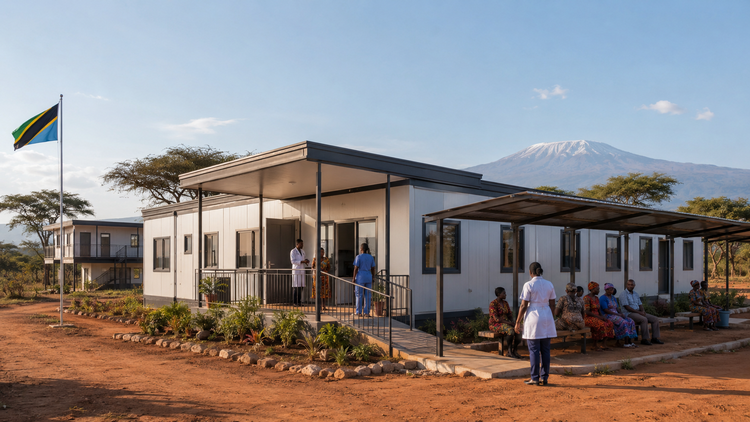
At Afripanel, we help healthcare planners, NGOs, government-linked projects, private operators, and rural development teams in Tanzania deploy reliable modular clinics for both immediate and long-term healthcare needs.
Whether your project needs a primary clinic, temporary emergency clinic, consultation rooms, waiting areas, admin offices, training centres, staff accommodation, or expandable healthcare support buildings, we can manufacture a solution around your exact requirements.
Table of Contents
- Why healthcare infrastructure matters to Tanzania’s economy
- Challenges facing Tanzania’s healthcare sector
- How modular construction supports healthcare delivery
- Afripanel solutions for healthcare infrastructure
- Why Afripanel is the right partner
- FAQ
- Build better healthcare infrastructure faster
Why Healthcare Infrastructure Matters To Tanzania’s Economy
Healthcare is not separate from Tanzania’s economic development. It supports the people who power the economy.
When communities can access healthcare faster, the impact reaches far beyond the clinic door. It supports workforce productivity, maternal and child health, rural economic participation, emergency response, school attendance, community stability and private and public investment confidence.
This is why healthcare infrastructure matters.
Tanzania’s growth in facility numbers shows meaningful progress, but the next challenge is placement, speed, and suitability. Facilities need to reach underserved regions. They need to support medical teams properly. They need to adapt as patient volumes change.
That is exactly where modular construction adds value.
Challenges Facing Tanzania’s Healthcare Sector
Tanzania’s healthcare sector is moving forward, but several practical constraints still affect delivery.
Uneven access to healthcare facilities
Some areas are better served than others. Fast-growing regions and rural communities may still face long travel distances to reach care.
This creates pressure on maternal care, child health, emergency response, primary consultations and chronic disease management.
A clinic that arrives one year late can mean thousands of missed consultations.
Health workforce shortages
Doctors, nurses, technicians, and support staff need proper working environments. In remote areas, staff accommodation can make the difference between a staffed clinic and a building that struggles to function.
Financing and rollout pressure
Healthcare budgets need to stretch. Traditional construction can introduce delays, cost uncertainty, and site disruption. For healthcare projects, that can slow down service delivery.
Rural and emergency healthcare gaps
Rural healthcare needs buildings that can be deployed quickly. Emergency healthcare needs even more speed. When a community needs a temporary emergency clinic, waiting months for conventional construction is not practical.
How Modular Construction Supports Healthcare Delivery
This is where modular infrastructure becomes a strategic solution for Tanzania’s healthcare sector.
Up to six times faster construction
In healthcare, speed affects outcomes. Our modular buildings can be completed up to six times faster than traditional construction.
This allows healthcare projects to open clinics sooner, deploy emergency facilities faster, accommodate medical staff quickly, and expand service capacity with less delay.
Immediate deployment in underserved areas
Our modular buildings are well suited to rural and remote locations where traditional construction can be difficult.
This makes them practical for rural clinics, temporary emergency clinics, mobile support points, district healthcare expansion and project-based healthcare facilities.
Flexible and scalable healthcare buildings
Patient demand changes. A small clinic may later need more consultation rooms. A temporary facility may need to become a longer-term healthcare support building.
Our buildings can be expanded, reconfigured, or relocated quickly and cost-effectively.
Cleaner, safer construction sites
Healthcare environments need quiet and order. Our construction approach creates neater, quieter and safer sites, which helps reduce disruption around active hospitals, clinics, and community facilities.
Better cost control
Our modular systems offer an affordable alternative to traditional brick-and-mortar construction, with potential cost savings of up to 30%. For healthcare projects, this helps budgets reach more communities.
Afripanel Solutions For Healthcare Infrastructure
We provide highly customised solutions tailored to healthcare projects. Templates can help speed up planning, but they are never the limit.
We can manufacture any realistic custom design supplied by the client, and our in-house engineers can sign off unique healthcare building requirements.
Modular clinics
We can deliver modular clinics for:
- primary care
- rural healthcare
- emergency response
- outreach programmes
- private healthcare sites.
These buildings can be designed around consultation flow, waiting areas, admin needs, and staff support.
Consultation rooms
The core of many healthcare facilities are consultation rooms. We can provide practical, customised spaces for:
- general consultations
- maternal and child health services
- follow-up appointments
- screening programmes.
Waiting areas
A well-planned waiting area reduces congestion and improves the patient experience. We can include waiting areas as part of a full modular clinic design.
Staff accommodation
Healthcare delivery in rural areas depends heavily on staff retention.
We can provide:
- staff housing
- shared accommodation
- management accommodation
- welfare spaces.
This helps healthcare teams remain close to the communities they serve.
Admin offices and support buildings
Healthcare facilities also need space for administration. We can deliver:
- reception offices
- records rooms
- management offices
- meeting rooms
- project coordination buildings.
Training centres
Training strengthens healthcare delivery. We provide buildings for:
- staff onboarding
- technical training
- community health worker training
- programme coordination.
Temporary emergency clinics
Emergency healthcare needs rapid response. Our modular systems can support temporary emergency clinics for sudden demand, project-based healthcare, or interim service delivery while permanent facilities are planned.
Expandable healthcare support buildings
Healthcare needs change over time. Our buildings can be expanded, reconfigured, and relocated, making them useful for growing districts, outreach programmes, and staged healthcare investments.
Turnkey buildings with optional utility add-ons
Our turnkey solutions include:
- custom-designed fittings and trimmings
- plumbing
- electrics
- air conditioning.
Optional add-ons include:
- solar power systems
- gas water heaters
- rainwater harvesting.
This is especially useful for remote clinics, schools, mines, or eco-lodges, and it can be valuable for healthcare projects where utility access is limited.
Why Afripanel Is The Right Partner
We combine speed, flexibility, and proven modular expertise.
Our benefits include:
- highly customised solutions
- turnkey delivery
- excellent quality and durability
- low maintenance requirements
- strong energy efficiency
- unbeatable value through direct-from-manufacturer pricing
- end-to-end or DIY solutions
- reliable cross-border freight across Sub-Saharan Africa
- over 20 years of experience
This allows you to deploy healthcare infrastructure faster and with greater confidence.
FAQ
What are modular healthcare buildings?
Modular healthcare buildings are prefabricated buildings used for clinics, consultation rooms, waiting areas, admin offices, staff accommodation, training centres, and emergency healthcare facilities.
Are modular clinics suitable for rural areas in Tanzania?
Yes. Modular clinics are well suited to rural areas because they can be deployed faster than traditional construction and customised around local healthcare needs.
Can modular healthcare buildings be expanded later?
Yes. Our buildings can be expanded, reconfigured, or relocated as patient demand and service requirements change.
What healthcare buildings can Afripanel provide?
We can provide modular clinics, consultation rooms, waiting areas, staff accommodation, admin offices, training centres, temporary emergency clinics, and expandable healthcare support buildings.
Can Afripanel deliver modular healthcare buildings to Tanzania?
Yes. We provide reliable cross-border freight delivery throughout Sub-Saharan Africa.
Build Healthcare Infrastructure Faster
Tanzania’s healthcare sector is growing. The question is whether infrastructure can reach communities quickly enough.
If you need modular clinics, consultation rooms, waiting areas, staff accommodation, admin offices, training centres, temporary emergency clinics, or expandable healthcare support buildings, we can help you deploy faster and scale smarter.
Fill in the enquiry form today and let’s design a modular healthcare solution tailored to your project in Tanzania.
Sources Consulted
Service Delivery Report: Mid-Term Review of the Health Sector Strategic Plan V
Author: Ifakara Health Institute / Ministry of Health Tanzania
Short summary: Best source for healthcare infrastructure trends. It shows Tanzania’s health facilities increased from 8,458 to 9,366 between 2020 and 2023, but also highlights uneven distribution, low facility density in Geita and Katavi, and the need for active investment in building and equipping facilities.
Link: https://ihi.or.tz/media/List_and_report/MTR_Service_Delivery_-_REPORT_hZBVRgG.pdf
Health Financing Report: Mid-Term Review of the Health Sector Strategic Plan V
Author: Ifakara Health Institute / Ministry of Health Tanzania
Short summary: Strong source for financing and operational constraints. It notes that health financing supports facility rehabilitation, healthcare worker training, and facility governance, but also identifies claim-management failures, financial losses for facilities, and reduced willingness to serve certain insured clients.
Link: https://ihi.or.tz/media/List_and_report/MTR_Health_Financing_-_REPORT.pdf
Tanzania Maternal and Child Health Investment Program
Author: World Bank
Short summary: Useful source for current healthcare investment and sector priorities. It focuses on scaling up and improving essential healthcare services, especially maternal and child health, and notes recent progress including health worker mentorship, recruitment of staff to primary healthcare facilities, and strengthened referral systems.
Link: https://documents1.worldbank.org/curated/en/099041525085594824/pdf/P170435-c443a5dd-73ec-414a-8256-18a7662e8151.pdf
Tanzania Human Resources for Health Assessment
Author: World Bank
Short summary: Best source for workforce challenges. It highlights human-resource constraints in healthcare and specifically recommends considering non-financial incentives such as career development and provision of accommodation.
Link: https://documents1.worldbank.org/curated/en/099063023140031025/pdf/P17987004053560808a1a0d12af8e73a38.pdf
Ministry of Health Medium-Term Strategic Plan 2021/22–2025/26
Author: Ministry of Health Tanzania
Short summary: Useful for policy direction and future opportunity. It sets out priorities including upscaling curative and preventive services, improving health commodity funding through insurance schemes, and engaging private-sector and NGO partners.
Link: https://www.moh.go.tz/storage/app/uploads/public/687/9f6/3fa/6879f63fad8f2963963184.pdf