
Modular Construction Securing Tanzania’s Agricultural Development
Modular buildings are a proven way to keep up with infrastructure demand, allowing farming operations, agribusinesses, and rural agriculture developments in Tanzania to scale faster, operate more efficiently, and reduce infrastructure delays that slow agricultural progress.
Agriculture remains one of Tanzania’s most important economic sectors, supporting millions of livelihoods and contributing significantly to exports. According to Tanzania’s Ministry of Agriculture, crop exports reached USD 3.54 billion in FY 2023/2024, representing a 51.9% increase from the previous financial year.
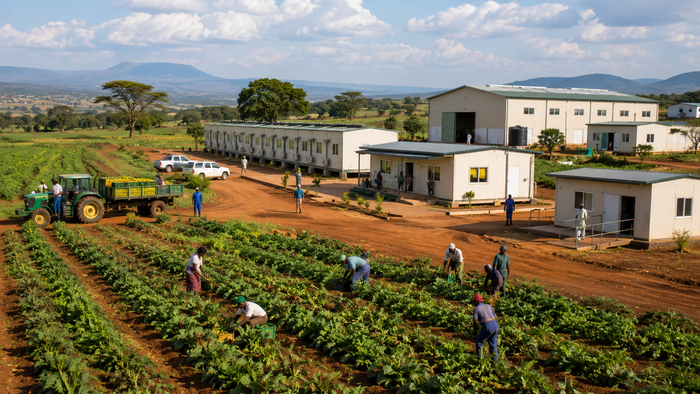
That level of growth creates a major opportunity. Yet it also exposes a challenge. Agricultural expansion requires better infrastructure, from worker accommodation and farm offices to warehouses, clinics, training centres, and processing support buildings.
The opportunity is already clear. Tanzania’s Ministry of Agriculture itself notes that: “Construction of post-harvest structures such as pack houses for sorting crops or cold facilities for storage of perishable crops is also an investment opportunity in all regions. Construction of warehouses for cereals storage is also an area of high demand.”
At Afripanel, we help agricultural operations overcome these challenges through highly customised modular agriculture infrastructure designed for African operating conditions.
Whether you are developing commercial farms, agricultural processing operations, livestock facilities, or regional food supply hubs, our modular construction systems help you deploy infrastructure faster and scale with confidence.
Table of Contents
- Why agriculture matters to Tanzania’s economy
- Challenges facing Tanzania’s agricultural sector
- How modular construction strengthens agricultural development
- Afripanel solutions for agricultural infrastructure
- Opportunities for agricultural expansion in Tanzania
- Why Afripanel is the right partner
- FAQ
Why Agriculture Matters To Tanzania’s Economy
Agriculture is not just another sector in Tanzania. It supports communities, employment, exports, food production, and regional economic development.
The sector also underpins food security, export earnings, livestock production, agro-processing, regional employment and rural economic development.
The good news is that Tanzania’s agricultural economy is growing. The Ministry of Agriculture reported that crop export earnings reached USD 3.54 billion in FY 2023/2024, highlighting the sector’s increasing importance to national growth.
This creates a major opportunity for agribusinesses, farmers, agricultural investors, and food supply operators.
However, agricultural growth depends on infrastructure. Without the right buildings in place, productivity slows, operational efficiency suffers, and expansion becomes difficult.
Challenges Facing Tanzania’s Agricultural Sector
Tanzania’s agricultural sector has strong long-term potential, but several practical challenges continue to affect growth.
Limited Post-Harvest Infrastructure
One of the biggest challenges is post-harvest handling. Many agricultural operators still face limited access to:
- storage facilities
- packhouses
- sorting areas
- cold storage support buildings
- grain warehousing.
Without this infrastructure, food loss increases and profitability suffers.
Remote Agricultural Operations
Many farms and agricultural developments operate in rural areas. This creates immediate demand for worker accommodation, site offices, clinics, welfare facilities and maintenance buildings.
Traditional construction is often slow, expensive, and difficult in remote locations.
Labour And Workforce Challenges
Agriculture depends on people. Without suitable accommodation and welfare infrastructure, staff retention and productivity become difficult.
Climate And Operational Pressures
Agricultural operations need buildings that can perform reliably over time while keeping maintenance demands low.
How Modular Construction Strengthens Agricultural Development
This is where modular agriculture infrastructure creates a clear advantage.
Up to six times faster construction
Our modular buildings can be completed up to six times faster than traditional construction.
That means:
- farms become operational sooner
- workers can be accommodated faster
- storage and admin facilities become available quickly
- agricultural expansion moves ahead without unnecessary delays.
Better infrastructure for remote locations
Rural farming environments require practical infrastructure solutions. Our buildings are designed to be delivered efficiently and deployed in challenging environments across Africa.
Flexible and scalable buildings
Agricultural projects evolve. A workforce camp for seasonal labour today may need to expand next season. A small farm office may later support a regional agricultural operation.
Our buildings offer extreme flexibility, allowing them to be expanded, reconfigured, or relocated quickly and cost-effectively.
Better cost certainty
Our modular systems offer an affordable alternative to traditional brick-and-mortar construction, with potential savings of up to 30%, depending on project requirements.
Safer and cleaner sites
We create neater, quieter and safer construction sites, reducing disruption around active farming operations.
Afripanel Solutions For Agricultural Infrastructure
We do not believe agricultural projects should be forced into rigid templates. We provide highly customised solutions designed around your operational requirements.
Our in-house engineers can sign off unique agricultural building requirements.
Farm worker accommodation
Agricultural operations need practical, reliable housing. This supports productivity and improves worker wellbeing. We provide:
- worker accommodation
- shared units
- management housing
- farm accommodation solutions.
Farm offices and administration buildings
We can deliver:
- plug-and-play offices
- administration buildings
- farm management offices
- meeting spaces
- operational control rooms.
Storage and agricultural support buildings
Agricultural projects rely on organised operations. Our modular buildings can support:
- agricultural storage
- equipment storage
- warehousing support
- processing administration
- maintenance buildings.
Clinics and welfare facilities
Many agricultural developments require welfare support for workers. We can provide:
- clinics
- consultation rooms
- ablution facilities
- welfare spaces.
Training and support centres
Agricultural skills development matters. We can deliver buildings for:
- workforce induction
- training programmes
- agricultural administration.
Turnkey buildings with optional utility add-ons
Our turnkey solutions include:
- custom-designed fittings and trimmings
- plumbing
- electrics
- air conditioning.
Optional add-ons include:
- solar power systems
- gas water heaters
- rainwater harvesting.
These is particularly useful for remote agricultural operations.
Opportunities For Agricultural Expansion In Tanzania
Tanzania’s agricultural future creates major opportunities for modular construction.
The Ministry of Agriculture already identifies strong demand for packhouses, cold storage support facilities and cereal warehouses.
Additional opportunities include livestock support infrastructure, farm offices, workforce accommodation, regional food logistics hubs, and agro-processing support facilities.
This is how modular buildings for agriculture in Tanzania can help secure long-term development.
Why Afripanel Is The Right Partner
We combine speed, flexibility, and proven modular expertise.
Our benefits include:
- highly customised solutions
- turnkey delivery
- excellent quality and durability
- low maintenance requirements
- strong energy efficiency
- unbeatable value through direct-from-manufacturer pricing
- end-to-end or DIY solutions
- reliable cross-border freight across Sub-Saharan Africa
- over 20 years of experience
This gives you confidence that your agricultural infrastructure can scale with your operation.
FAQ
What are modular buildings for agriculture in Tanzania?
These are prefabricated buildings used for farm worker accommodation, offices, clinics, storage, welfare facilities, and agricultural support operations.
Can modular buildings be used on remote farms?
Yes. They are particularly effective in remote agricultural locations where traditional construction is slow or expensive.
Are modular agricultural buildings expandable?
Yes. Our buildings can be expanded, reconfigured, or relocated as your agricultural operation grows.
Can Afripanel deliver to Tanzania?
Yes. We provide reliable cross-border freight delivery throughout Sub-Saharan Africa.
Build Your Agricultural Infrastructure Faster
Tanzania’s agricultural sector is growing. The question is whether your infrastructure is ready to support that growth.
If you need worker accommodation, farm offices, storage support buildings, clinics, or fully customised modular agriculture infrastructure, we can help you deploy faster and scale smarter.
Fill in the enquiry form today and let’s design a modular solution tailored to your agricultural project in Tanzania.
Sources Consulted
Tanzania Economic Update: Harnessing the Opportunity for a Climate-Smart and Competitive Livestock Sector in Tanzania
Author: World Bank
Short summary: Strong source for livestock, food security, and climate-smart agriculture. It notes Tanzania has 36.6 million cattle, the second-largest cattle population in Africa, and highlights input access challenges including breeds, vaccines, feed supplements, and veterinary services.
Link: https://documents1.worldbank.org/curated/en/099081524060016951/pdf/P17961019db2eb013193781c2280fd79237.pdf
Country Climate and Development Report: United Republic of Tanzania
Author: World Bank
Short summary: Best source for long-term agricultural transformation and climate-risk framing. It explains that Tanzania’s agricultural transformation is expected to shift from expansion and commercialisation toward agriculture-driven industrialisation, with labour moving gradually from agriculture into services and industry.
Link: https://documents1.worldbank.org/curated/en/099121924163520324/pdf/P18018715c2c9e0651b367172fb62ee6b60.pdf
Tanzania Agricultural Policy Profile
Author: CGIAR
Short summary: Useful for policy and trend context. It highlights Tanzania’s focus on modernising agriculture, improving infrastructure, enhancing market access, adopting technology, and building resilience against climate change and market-access barriers.
Link: https://cgspace.cgiar.org/bitstreams/61886609-cbc1-462a-a1d3-c8d5eb538f76/download
Agriculture Annual Report 2023/2024
Author: Ministry of Agriculture, United Republic of Tanzania
Short summary: Best source for Tanzania-specific agricultural challenges and opportunities. It identifies low input intensity, limited mechanisation, post-harvest inefficiencies, climatic dependency, irrigation gaps, and high demand for packhouses, cold storage, and cereal warehouses. It also states crop exports reached USD 3.54 billion in FY 2023/2024, up 51.9% from FY 2022/2023.
Link: https://www.kilimo.go.tz/uploads/documents/sw-1747227277-Agriculture%20Annual%20Report%202023%20-%202024%20compressed.pdf
Tanzania 2024 Constraints Analysis Report
Author: Millennium Challenge Corporation
Short summary: Useful for business-environment constraints. It notes that agricultural exporters face delays in VAT refunds and broader formalisation challenges, which helps frame why faster, cost-certain infrastructure is valuable for agribusinesses trying to scale.
Link: https://assets.mcc.gov/content/uploads/constraints-analysis-tanzania-2024.pdf